The Place-Based Manufacturing Recipe
In 1976, the R.L. Winston Rod Company left San Francisco. Rent wasn't the problem, and neither was the market. Owners Tom Morgan and Glenn Brackett moved the shop to Twin Bridges, Montana, because of the water: the town sits where the Beaverhead, Big Hole and Ruby rivers meet to form the Jefferson. Twin Bridges had a few hundred people.
Nearly fifty years later, Winston is still on Main Street. Blanks are rolled in the shop and rods are wrapped by hand. Anglers still come to see where the rods are made.
This piece is about companies like Winston: businesses that chose a place, stayed when leaving would have been easier, and found the commitment working in their favor. Fourteen are profiled here. They range from a fly-rod shop to a dairy cooperative that draws more than a million visitors a year. They make wool blankets, cast iron, boots, socks and flour, in towns from a few hundred people to about 87,000.
What they share is hard to put in a spreadsheet. Each is tied to a named place. Each competes on craft rather than cost. Each has owners who never planned a quick exit, which gives them capital patient enough to wait on a place. And each has been at it for decades, some for generations.
Is that an accident, or a pattern? Read together, these companies point to eight recurring patterns, six conditions in the communities that sustain them, and three ways the model breaks. Not every company shows every pattern, and the exceptions turn out to be some of the most useful evidence.
What makes a manufacturer place-based
Every business is local somewhere. A place-based manufacturer is one that made its location a deliberate choice, so that the place becomes part of what the customer is buying.
Red Wing boots are made in Red Wing, Minnesota. The name on the boot is the name on the map, and that match is the brand's most durable asset. A competitor can copy the last, the leather and the stitch. It cannot make a boot in Red Wing without being in Red Wing. The same holds for Pendleton, Duluth Pack and Faribault. This is a competitive strategy, not nostalgia.
Place matters in a second, less visible way: the knowledge that builds up in one location over decades. An experienced weaver reads fiber under tension. A die-setter learns the habits of one press over years at the same machine. A plant manager remembers which supplier's material behaves differently in a humid August. The philosopher Michael Polanyi called this tacit knowledge: it lives in people and relationships, and it doesn't survive being written into a manual (Polanyi 1966). Management research has since shown how much of a manufacturer's capability rests on it, and how hard it is to rebuild once a production base leaves (Nonaka and Takeuchi 1995; Pisano and Shih 2009). A company that keeps its operation in one place for fifty years is building an asset its competitors would need decades to copy.
One distinction runs through the cases below. Some of these companies are still primarily makers. Others grew large enough to become brands, and then retailers, selling far more than they make. The successful ones in that second group kept making their defining product in the place that gave it its name. That thread comes back in the recipe.
The fourteen companies
The companies span eight states and five industries. All are privately held by families, employees or farmer-members, and few publish financial statements, so this piece reports what can be sourced and leaves revenue out. Populations are from the 2020 Census.
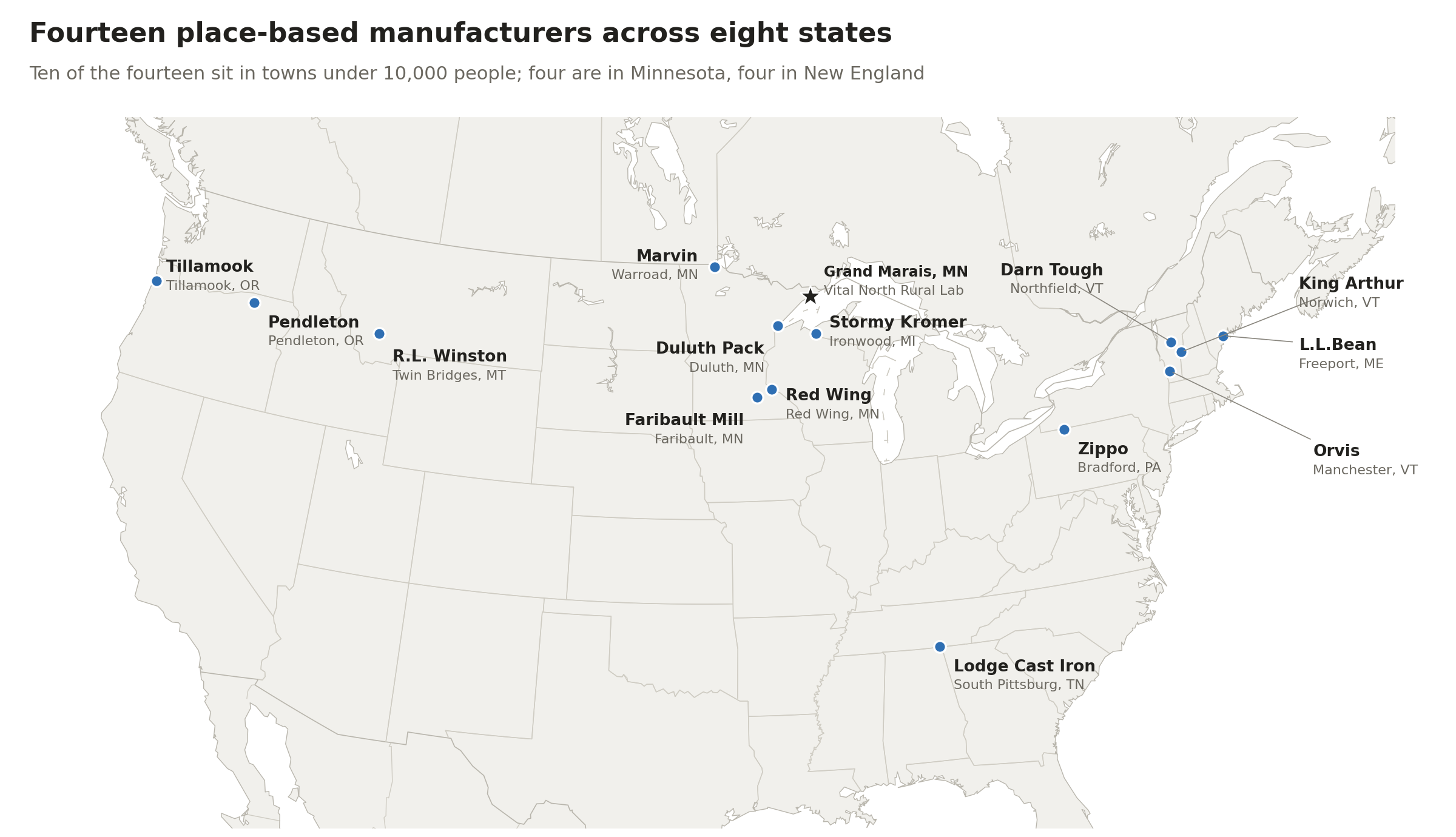
The Minnesota cluster
Marvin — Warroad, MN (pop. 1,830). George Marvin came to Warroad in 1904 to run a grain elevator and lumberyard. After World War II his son Bill bought woodworking machinery, over his father's objections, so returning veterans would have work at home. Marvin is still family-owned in its fourth generation and still headquartered and manufacturing in Warroad, with more than 5,500 employees across 16 locations (Marvin n.d.; Prairie Business n.d.). Made-to-order windows are hard to offshore, and Marvin built its moat on that.
Red Wing Shoe Company — Red Wing, MN (pop. 16,547). Founded in 1905 and run by the Sweasy family for four generations. Heritage boots are still made in Red Wing and Potosi, Missouri, from leather tanned by S.B. Foot, a Red Wing tannery the company acquired in 1986 (Red Wing Shoe Company n.d.; MNopedia n.d.). Some sub-brands are made in Asia. The boot that carries the town's name stays home.
Faribault Mill — Faribault, MN (pop. 24,453). Founded in 1865 and run by the Klemer family for 136 years, the mill was sold to an investor in 2001 and closed in 2009 (Star Tribune n.d.). In 2011 Chuck and Paul Mooty bought it, rehired former workers and repositioned it as a premium, place-made brand (Twin Cities Business n.d.). The revival is real but unfinished: in 2020 Paul Mooty called the business solid but not yet profitable (Star Tribune 2020).
Duluth Pack — Duluth, MN (pop. 86,697). Camille Poirier patented his canvas pack sack in 1882, and it became the standard Boundary Waters portage pack. About 75 people still make it in Duluth (Duluth Pack n.d.; Busche 2023). The city is larger than the others here, but the model of a small team, a specific craft and a store that draws visitors scales down to smaller towns.
The New England standard
L.L.Bean — Freeport, ME (pop. 8,737). Founded in 1912 around one product, the Maine Hunting Shoe, and still family-owned and headquartered in Freeport. L.L.Bean is now mostly a retailer, but its boots are still made by several hundred workers in Brunswick and Lewiston, Maine (L.L.Bean n.d.; Associated Press n.d.).
Orvis — Manchester, VT (pop. 4,484). Founded in Manchester in 1856 and owned by the Perkins family since 1965. It grew into a national retailer of about 1,800 employees, and in 2024 moved its headquarters back to its Manchester campus beside the flagship store, fly-fishing school and rod shop (VTDigger 2024a). Months later it cut 8 percent of its workforce, closed stores and ended its catalog (VTDigger 2024b).
Darn Tough Vermont — Northfield, VT (pop. 5,918). Marc Cabot opened Cabot Hosiery Mills in Northfield in 1978. When its private-label business neared failure, his son Ric launched Darn Tough in 2004, giving socks away at the Vermont City Marathon and backing every pair with an unconditional lifetime guarantee (Boston Globe 2016; Family Business Magazine n.d.). The guarantee is a statement of confidence in the knitting, and it made the brand.
King Arthur Baking — Norwich, VT (pop. 3,612). Founded in Boston in 1790 as a flour distributor, it moved to Norwich in 1984. An employee buyout began in 1996, and the company has been fully employee-owned since 2004 (Baking Business n.d.; VEOC n.d.). King Arthur doesn't mill flour. What it makes in Norwich is baking knowledge, through a bakery, store and baking school.
The single-object masters
Stormy Kromer — Ironwood, MI (pop. 5,045). George Kromer's wool cap dates to 1903 and was made in Milwaukee for most of a century. By 2001 sales had fallen to about 3,900 caps a year, and Bob Jacquart, whose family ran a sewing factory in Ironwood, bought the line (UP Travel n.d.). About 90 sewers and cutters now make it there, and the factory gives tours (Alliance for American Manufacturing 2019).
R.L. Winston Rod Co. — Twin Bridges, MT (pop. 330). Founded in San Francisco in 1929 and moved to Twin Bridges in 1976 to be near the rivers (Fly Life n.d.). It built a fully integrated rod plant there in 1995. Its rods are made in Twin Bridges (R.L. Winston Rod Co. 2012).
Zippo — Bradford, PA (pop. 7,849). Founded in Bradford in 1932. Its lighters have been made there ever since, apart from a plant in Niagara Falls, Ontario, that ran from 1949 to 2002 (Zippo Canada n.d.). Zippo made its 500-millionth lighter in Bradford in 2012 (NBC News 2012).
Family and cooperative owners
Tillamook County Creamery Association — Tillamook, OR (pop. 5,204). A cooperative founded in 1909 and owned by dairy farm families, nearly 90 of them in 2019. It employed about 900 people and its creamery drew more than a million visitors a year (TCCA 2019). Because the farmers own the brand, a sale or a move would require them to vote against their own farms.
Lodge Cast Iron — South Pittsburg, TN (pop. 3,106). Founded in 1896 and still family-owned, with two foundries in town. In 2021 it announced an expansion expected to create 239 jobs (Tennessee ECD 2021). Its commitment to South Pittsburg has lasted for generations.
Pendleton Woolen Mills — Pendleton, OR (pop. 17,107). The family traces its craft to Thomas Kay, a weaver who arrived in Oregon in 1863. In 1909 his grandsons rebuilt a defunct mill in Pendleton with the help of a local bond issue, so the town helped finance its namesake (Encyclopedia.com n.d.-a). The company is now in its sixth generation and headquartered in Portland, and its mills in Pendleton and Washougal, Washington, still run (Pendleton Woolen Mills n.d.).
A small town is not a ceiling on growth
A small town is not a ceiling on growth. Among these companies, the size of the home town tells you almost nothing about the size of the company. Marvin employs more than 5,500 people from a town of 1,830, three times the town's population. Duluth Pack employs about 75 in a city of nearly 87,000. Orvis and Tillamook each employ hundreds or more from towns of roughly 4,500 to 5,200.
The lesson for a small community is that large growth is achievable from a small base. What drives scale is the product, the brand and the patience of the capital, not the size of the labor market at the front door. Two cautions keep that lesson honest. These examples are too few to measure a statistical relationship; they show that small towns don't cap growth, not that they cause it. And the largest companies grew partly by adding plants and stores elsewhere while keeping their headquarters and hero product at home. Marvin now has 16 locations, and Tillamook added a second plant in Boardman. A small town can anchor a large company, but it usually can't house all of it, which is why housing and workforce show up among the North Shore's gaps.
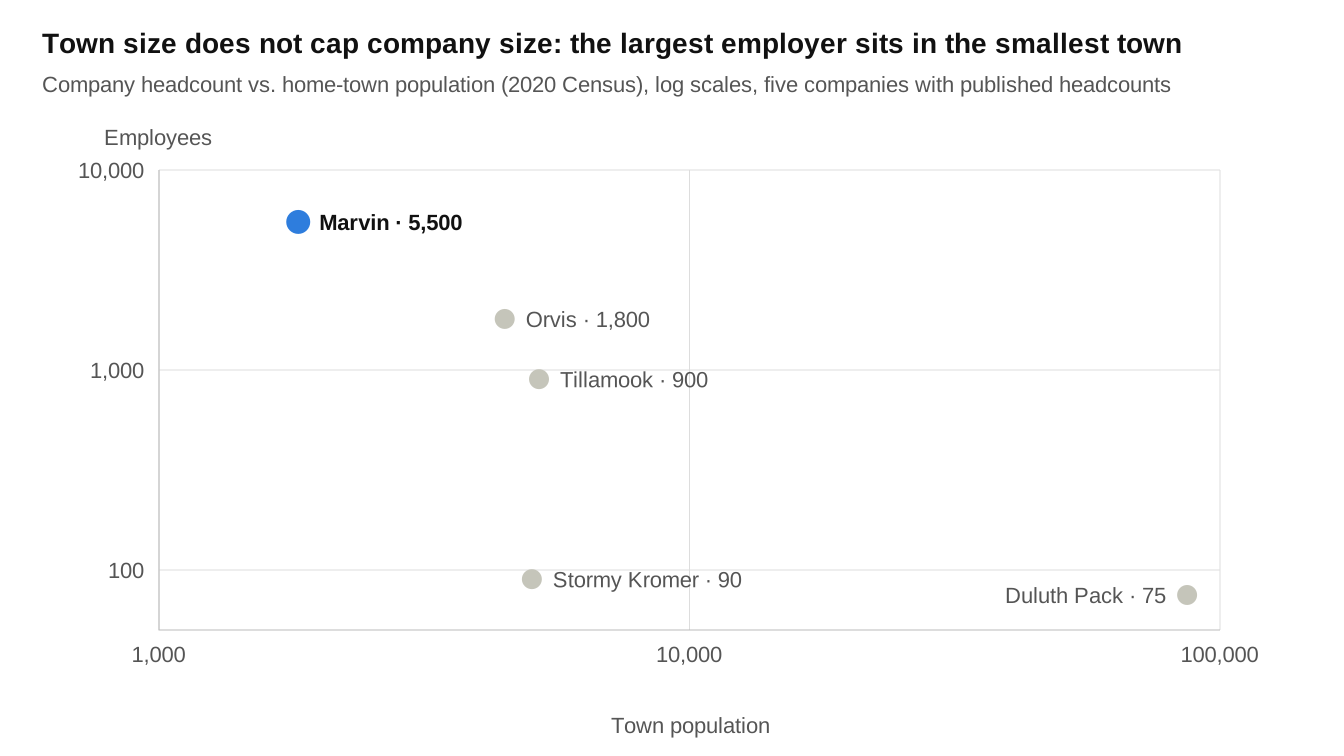
Company-wide headcounts as published: Marvin (Prairie Business n.d.), Orvis (VTDigger 2024a), Tillamook (TCCA 2019), Duluth Pack (Busche 2023). Stormy Kromer counts production staff only (Alliance for American Manufacturing 2019). Populations: 2020 Census.
The recipe
Eight patterns show up across most of these companies, regardless of industry or geography. None appears in all fourteen, and the exceptions are noted.
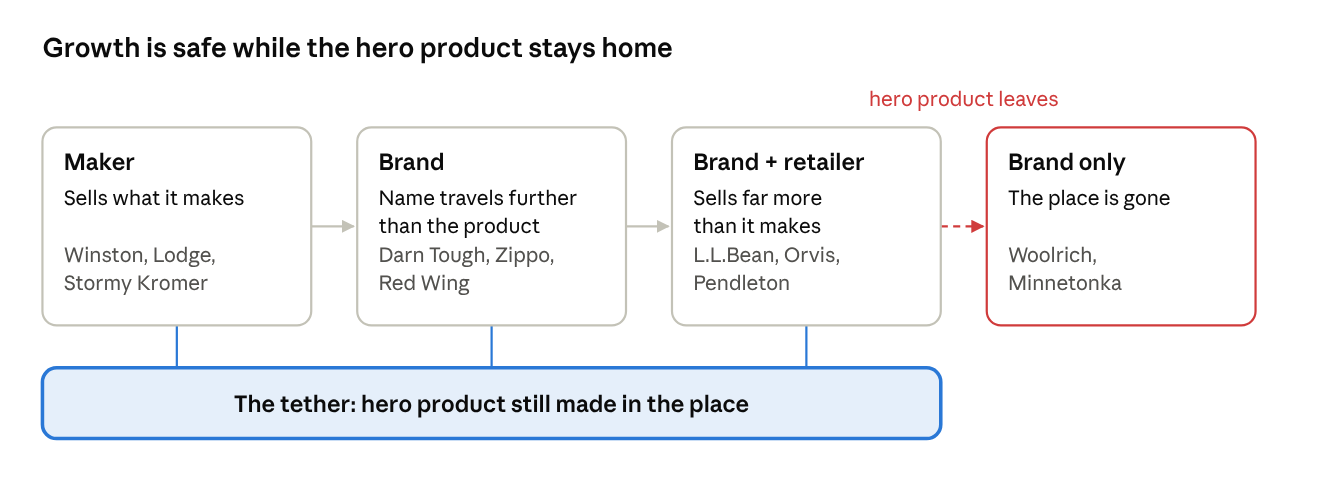
The growth path: maker → brand → brand and retailer. The tether is the hero product still made at home; the failure mode begins when it leaves.
1. The place name is the brand
Red Wing. Pendleton. Duluth. Faribault. Tillamook. When the product and the town share a name, the geography is identity, and leaving would mean breaking the brand. The protection doesn't come from trademark law. It comes from the plain fact that the product is made where its name says it is. Where the brand isn't a town name (Lodge, Zippo, Marvin), the company has usually made the town famous instead.
2. Quality that resists commoditization
Custom windows. Boots that get resoled instead of replaced. Blankets that outlast their owners. Socks with a lifetime guarantee. The shared logic is to make something well enough that it can't be copied at lower cost without destroying the quality that is the whole proposition. That keeps production complex enough that offshoring doesn't pay, even with a large labor-cost gap.
3. The factory becomes a destination
Tillamook's creamery. Lodge's Museum of Cast Iron and factory store. Stormy Kromer's factory tours. L.L.Bean's Freeport flagship. The production site becomes somewhere people travel to, and visitor spending multiplies the return on local manufacturing in a way a distributed supply chain can't (TCCA 2019; Tennessee ECD 2021). The factory is the marketing budget.
4. Long-horizon ownership
Marvin, fourth generation. Lodge, fifth. Pendleton, sixth. Orvis, three generations of Perkins. King Arthur, employee-owned. Tillamook, owned by its farmers. None of these was built for a five-year exit. Patient capital is the structural condition that lets a company invest across decades in people, machinery and community. Winston is the partial exception: it has changed hands several times, and has survived because each owner chose to keep it in Twin Bridges.
5. A hero product that stays home
The Kromer cap. The Bean Boot. The Pendleton blanket. The Zippo lighter. The Darn Tough sock. Each brand began with one product so specific and so good it became a category of its own. The hero product earns the trust that line extensions spend.
It also does a second job as a company grows. Pendleton, Orvis and L.L.Bean became so successful that they turned into brands and then retailers, selling far more than they make. What held them to their places was the hero product. L.L.Bean sells a global catalog, but the boot is still stitched in Maine. Orvis has stores across the country, but its rods are built behind the Manchester flagship. Pendleton is run from Portland, but its blankets still come off looms in Pendleton. Red Wing makes some sub-brands in Asia, but the Heritage boot is made in Red Wing.
The lesson is a lifecycle: maker, then brand, then brand and retailer. Each stage is safe as long as the hero product is still made in the place. When the hero leaves too, the company has crossed into the first failure mode below.
6. Knowledge kept through continuity
Long employment at the same facility is how embodied manufacturing knowledge passes from experienced workers to newer ones (Nonaka and Takeuchi 1995; Pisano and Shih 2009). Faribault shows what that knowledge is worth: when the mill reopened in 2011, most of its first 35 workers were former employees, which is part of why reopening was possible at all (Home Textiles Today 2011). That knowledge takes decades to build, so the companies that last are deliberate about passing it on rather than leaving it to chance.
7. Ownership that resists extraction
Tillamook's farm families. King Arthur's employee owners. Lodge's family shareholders. The specific legal structure matters less than the result: value goes to stakeholders with long time horizons and local roots, and no single investor can force a sale or a move. Family ownership can do this too, as long as the family stays committed. Woolrich, below, shows what happens when it doesn't.
8. The brand survives the crisis
Faribault closed in 2009. Stormy Kromer was down to a few thousand caps a year in 2001. Darn Tough's parent mill nearly failed in the early 2000s. Each was revived by people who saw that the story was intact even when the business wasn't. A brand built on a real place, real craft and a real community relationship holds value after operational failure in a way a brand built on marketing alone does not.
What communities need
Place-based manufacturing doesn't happen by accident. Six conditions show up repeatedly in the communities that sustain it, either present from the start or built over time.
1. A distinctive place identity that outsiders recognize
The place has to mean something to someone who doesn't live there. Landscape works: the Boundary Waters, the Oregon coast, Montana's trout rivers. So does history, like iron range or logging country, and so does recreation, like ski towns and fishing destinations. Outside recognition is what lets a brand charge a premium beyond its local market.
2. An honest material story
It's tempting to argue that place-brands depend on local raw materials. The evidence doesn't support that. Stormy Kromer sources some of its wool globally, and Faribault has long used imported wool (Alliance for American Manufacturing 2019; Twin Cities Business n.d.). What these brands need is a material story that is true: real wool, leather or cast iron, worked in the place the label names. Red Wing's ownership of its own tannery in Red Wing is the strong version. A claim of local material that isn't true is the fastest way to turn a place-brand into a marketing fiction.
3. A visitor economy, existing or buildable
The factory as a destination is the most financially powerful mechanism in this study, but it needs either existing visitor traffic or the scale to create it. Tillamook draws over a million visitors to a town of about 5,200. Stormy Kromer makes it work in Ironwood at a much smaller scale. Communities that already have visitors start ahead.
4. Patient capital aligned with community outcomes
The most reliable way to break a place-based brand is capital that expects to extract value on a short clock. Private equity and venture structures built for five-year returns sit poorly with twenty-year horizons. The alternatives — family capital, employee ownership, cooperatives, community development lenders, revenue-share notes, even municipal bonds — are operating requirements, not ethical preferences.
5. A product that earns its premium, continuously
None of these brands competes on price. The product has to justify its premium every year through craft, durability and an honest origin. When quality slips to chase volume, the premium erodes, the story goes hollow, and the economics that pay local wages stop working.
6. Community skin in the game
In the resilient cases, the community had real economic and emotional stakes in the company. Pendleton's mill was rebuilt in 1909 with the help of a local bond issue (Encyclopedia.com n.d.-a). Warroad has organized much of its economy and identity around Marvin for four generations. Community buy-in is a form of resilience that shows up in a crisis.
How it breaks
Three failure modes have ended or nearly ended place-based brands. All three are visible well in advance, and all three tend to arrive at the same moment: a change of ownership.
The brand survives, but the place doesn't
Woolrich is the clearest case. Founded in 1830, it ran a mill in Woolrich, Pennsylvania, from 1845, the oldest continuously operating woolen mill in the country. Through the 1990s the company closed most of its other U.S. plants (Encyclopedia.com n.d.-b). An Italian licensee took majority control in 2016, and a Luxembourg investment firm bought the business in 2018. Months later the new owners announced the mill would close, citing the capital needed to modernize it (SGB Media 2018). A textile entrepreneur offered to buy the mill and was turned down (Alliance for American Manufacturing n.d.). Woolrich is still a brand. It is no longer a place.
Minnesota has its own example. Minnetonka, the moccasin company, once made its shoes in Minnesota and now makes them in the Dominican Republic and China (NPR 2021). It kept the name and the story, and lost the place that made the story true.
This failure rarely happens overnight. It is a series of individually defensible decisions that together hollow out the thing that made the brand worth buying.
Quality slips to chase volume
Premium place-brands die when they try to compete at mass-market prices. Faribault is the warning. By the time it closed, its new owners said, it had become "the cheap blanket in the closet" and had given up almost everything a brand needs to sustain itself (Twin Cities Business n.d.). The revival worked by reversing that logic: fewer, better, more expensive blankets with an honest story.
Extractive capital breaks the model
Capital on a short clock will predictably push a place-based brand to cut wages, offshore production, defer investment or sell to a buyer who will. Faribault's slide began after its 2001 sale to an investor, which ended 136 years of family management (Star Tribune n.d.). Woolrich's mill closure was announced within months of its sale to an investment firm (SGB Media 2018). Patient, community-aligned capital keeps the model intact over the twenty-to thirty-year horizon it needs.
The practical lesson for anyone watching a place-based business change hands: the sale is the moment of greatest risk. New owners who don't understand what they are buying are how good companies become marketing fictions.
Why it holds: robust brands, fragile businesses
Nassim Nicholas Taleb (2012), in Antifragile, sorts systems into three kinds: fragile ones break under stress, robust ones resist it, and antifragile ones get stronger from it. It is tempting to call these companies antifragile. The record says something more precise.
The businesses are often fragile. Faribault closed. Stormy Kromer nearly vanished. Darn Tough's parent mill came close to failing. Orvis cut staff in 2024. Place-based companies are small, concentrated and exposed, and they fail the way small businesses fail.
The brands are robust, and in a few cases close to antifragile. A brand whose identity is a geographic fact can't be undercut by a competitor's marketing. It survives the failure of the business that carries it, waiting for someone to pick it up. And the stories of near-death become part of the brand: Darn Tough's marathon giveaway, Faribault's equipment tagged for shipment to Pakistan (Faribault Daily News n.d.), the Kromer cap down to 3,900 a year. Each crisis, survived, makes the story harder to copy.
That split is the most useful thing the antifragility lens offers. Protecting a place-based company means protecting two different things. The brand needs honesty: keep making the hero product in the place. The business needs patient capital and a community that will show up when it stumbles.
Market breadth matters too. Most of these companies make things with broad appeal: blankets, socks, cookware, boots, cheese. A beautifully made product for a narrow, culturally specific market can be stranded by a single shift in taste. The model is strongest where place-based craft meets a product people use every day.
What to do with this
For businesses: place is a moat. A real commitment to a named location builds a brand asset competitors can't copy, a knowledge base that takes decades to replicate, and a community that shows up in a crisis. If you grow into a brand or a retailer, keep the hero product at home. The most important capital decision a place-based manufacturer makes is the decision to stay, and to build as though it means to stay for a hundred years.
For communities: recruit and protect, don't just attract. A community that helps a manufacturer build knowledge and roots over twenty years ends up with something far more durable than a tax-incentivized plant that leaves when the incentive expires. The asset worth protecting isn't the building. It is the accumulated skill, the supplier network and the shared identity.
For investors and policymakers: the ecosystem matters more than any single plant. Regional clusters of related firms and suppliers build advantages no single company can (Porter 1990), and a strong production base feeds innovation as well as jobs (Berger 2013). Apprenticeships, community development lending, employee-ownership conversions and local bond financing create the conditions for those clusters. Pendleton's 1909 bond issue is a century-old proof of concept.
Closer to home: the North Shore
The Vital North Rural Lab exists to ask what patterns like these mean for the Arrowhead. Measured against the six conditions, the North Shore starts with real advantages and real gaps.
The advantages are significant. Lake Superior and the Boundary Waters give the region a place identity recognized far beyond Minnesota, and one of the brands in this study, Duluth Pack, was built for Boundary Waters portages. A strong visitor economy already brings people through Grand Marais and up the shore every season. And the region has living craft traditions, from boatbuilding and timber framing to the work taught at North House Folk School. Lamppa Manufacturing, a fourth-generation family business in Tower, has grown its Kuuma sauna stoves largely by word of mouth, which shows that northern craft can find buyers well beyond the region (Duluth News Tribune n.d.).
The gaps are just as real: patient capital in small amounts, housing and workforce for a manufacturer to grow into, and products with broad enough appeal to carry a premium beyond a niche.
The recipe also points to where the leverage is. The highest-risk moment for any place-based business is a change of ownership, and the North Shore will see many of them as owners retire. Each one is a chance to keep a business local, to restructure it for patient or employee ownership, and to ask whether it has a hero product the region could make famous. Whether that happens depends less on any one buyer than on whether the community has the capital and the will to act when a business comes up for sale.
A note on this research
Written by Sam Usem. The thoughts, company selections, analysis and editorial judgments are my own. Research was assisted by a variety of OpenAI and Anthropic models available through my Pro subscriptions.
Town populations are from the 2020 Census. This is an essay built on case evidence, not a systematic study: the companies were chosen because they illustrate the model, so the patterns describe what success looks like more reliably than how often it happens.
Appendix: the companies at a glance
Sorted by town population (2020 Census), smallest first. "Hero product made at home" means the defining product is still made in or near the named town. Sources for each row are cited in the profiles.
| Company | State | Town population (2020) | Founded / arrived | Ownership | Hero product made at home |
|---|---|---|---|---|---|
| R.L. Winston Rod Co. | MT | 330 | 1929 / 1976 | Private | Yes |
| Marvin | MN | 1,830 | 1904 | Family, 4th generation | Yes |
| Lodge Cast Iron | TN | 3,106 | 1896 | Family | Yes |
| King Arthur Baking | VT | 3,612 | 1790 / 1984 | 100% employee-owned | Not a mill; school and bakery in Norwich |
| Orvis | VT | 4,484 | 1856 | Family (Perkins) | Rods, yes |
| Stormy Kromer | MI | 5,045 | 1903 / 2001 | Family (Jacquart) | Yes |
| Tillamook | OR | 5,204 | 1909 | Cooperative | Yes, plus Boardman, OR |
| Darn Tough Vermont | VT | 5,918 | 1978 / 2004 | Family (Cabot) | Yes |
| Zippo | PA | 7,849 | 1932 | Family | Yes |
| L.L.Bean | ME | 8,737 | 1912 | Family | Boots, in Brunswick and Lewiston |
| Red Wing Shoe Co. | MN | 16,547 | 1905 | Family (Sweasy), 4th generation | Heritage line, yes |
| Pendleton Woolen Mills | OR | 17,107 | 1863 / 1909 | Family, 6th generation | Yes, plus Washougal, WA |
| Faribault Mill | MN | 24,453 | 1865 | Private (reopened 2011) | Yes |
| Duluth Pack | MN | 86,697 | 1882 | Private | Yes |
References
-
Alliance for American Manufacturing. 2019. "The Stormy Kromer Hat Remains a Cold Weather Staple, 116 Years After Its Launch."
-
Alliance for American Manufacturing. n.d. "Woolrich's American Mill Closure Is a Failure of Made in USA Investment, Not Value."
-
Associated Press. n.d. "L.L. Bean Boosting Production of Iconic Boot." Manufacturing.net.
-
Baking Business. n.d. "Holding to Founding 1896 Principle Pays Dividends at King Arthur Baking."
-
Berger, Suzanne, with the MIT Task Force on Production in the Innovation Economy. 2013. Making in America: From Innovation to Market. Cambridge, MA: MIT Press.
-
Boston Globe. 2016. Profile of Cabot Hosiery Mills and Darn Tough Vermont. April 21, 2016.
-
Busche, Andrea. 2023. "Duluth Pack Turns 141." Destination Duluth.
-
Duluth News Tribune. n.d. "Stove Company Pipes in Revival for Tower, Iron Range."
-
Duluth Pack. n.d. "Our Storied History."
-
Encyclopedia.com. n.d.-a. "Pendleton Woolen Mills, Inc." International Directory of Company Histories.
-
Encyclopedia.com. n.d.-b. "Woolrich Inc." International Directory of Company Histories.
-
Family Business Magazine. n.d. "This Family Firm Is Not Run-of-the-Mill."
-
Faribault Daily News. n.d. "Weaving a Legacy Loomed in the Land of Lakes."
-
Fly Life Magazine. n.d. "A Part of Fly-Fishing History Is Gone."
-
Home Textiles Today. 2011. "Faribault Blanket Mill Back On Line." November 15, 2011.
-
L.L.Bean. n.d. "Company Information." PDF.
-
Marvin. n.d. "History of Marvin."
-
MNopedia. n.d. "Sweasy, William D. (1916–1991)." Minnesota Historical Society.
-
NBC News. 2012. "Zippo Manufactures Its 500 Millionth Lighter." Associated Press.
-
Nonaka, Ikujiro, and Hirotaka Takeuchi. 1995. The Knowledge-Creating Company. New York: Oxford University Press.
-
NPR. 2021. "Moccasin Maker Minnetonka Has Apologized for Appropriating Native American Culture." October 12, 2021.
-
Pendleton Woolen Mills. n.d. "Company Information."
-
Pisano, Gary P., and Willy C. Shih. 2009. "Restoring American Competitiveness." Harvard Business Review, July–August.
-
Polanyi, Michael. 1966. The Tacit Dimension. Garden City, NY: Doubleday.
-
Porter, Michael E. 1990. The Competitive Advantage of Nations. New York: Free Press.
-
Prairie Business. n.d. "Stronger Together at Door and Window Manufacturer Marvin."
-
R.L. Winston Rod Co. 2012. Product catalog.
-
Red Wing Shoe Company. n.d. "About Us."
-
SGB Media. 2018. Report on the Woolrich mill closure.
-
Star Tribune. n.d. "A History of Faribault Woolen Mills."
-
Star Tribune. 2020. "Faribault Woolen Mill Gets New CEO, Infusion of Cash."
-
Taleb, Nassim Nicholas. 2012. Antifragile: Things That Gain from Disorder. New York: Random House.
-
Tennessee Department of Economic and Community Development (Tennessee ECD). 2021. "Governor Lee, Commissioner Rolfe Announce Lodge Manufacturing Company to Expand Marion County Operations." October 22, 2021.
-
Tillamook County Creamery Association (TCCA). 2019. "Tillamook to Unveil New Brand Identity in Celebration of Their 110th Anniversary." Press release, February 12, 2019.
-
Twin Cities Business. n.d. "How Faribault Woolen Mill Revived a 150-Year-Old Brand."
-
UP Travel. n.d. "Stormy Kromer Hats." Upper Peninsula Travel and Recreation Association.
-
U.S. Census Bureau. 2021. 2020 Census, population of incorporated places and towns.
-
Vermont Employee Ownership Center (VEOC). n.d. "King Arthur Baking Company."
-
VTDigger. 2024a. "Outdoor Retailer Orvis to Sell Sunderland Headquarters, Move to Manchester." January 29, 2024.
-
VTDigger. 2024b. "Orvis, a Vermont-Based Outdoor Gear and Apparel Company, to Cut 8% of Its Workforce." October 4, 2024.
-
Zippo Canada. n.d. "Zippo Canada 65th Anniversary Limited Edition."